
Are 1950s Vacation Homes Safe for Kids? 7 Checks
Last Updated: October 26, 2026
Quick Summary
A well-maintained 1950s vacation home can be perfectly safe for kids, while a neglected one cannot, so the condition of the house matters more than its age. Before booking 1950s vacation homes, check lead paint, electrical grounding and GFCI outlets, and stair and window safety.
Homes built before 1978 may contain lead-based paint, so ask whether surfaces were tested or repainted.
A $20 lead swab kit, a $10 outlet tester, and a tape measure cover the three highest-risk categories in about fifteen minutes.
Measure baluster gaps on every railing, since a 4-inch sphere should not pass through any gap.
Ask the host in writing through the booking platform so the safety answers are documented.
Assign one adult as water watcher at all times and rotate every 30 minutes.
Table of Contents
Why 1950s Vacation Homes Need a Closer Look
The Real Hazards in Vintage Architecture
Lead Paint and Asbestos in Older Rentals
Electrical Grounding and Outlet Safety
Staircases, Railings, and Windows
Childproofing a Vacation Rental Before You Arrive
Your Child-Safe Vacation Rental Checklist
Questions to Ask a Vacation Rental Host About Child Safety
Beach House Safety Tips for Families
Supervision, Not Nostalgia: Setting Modern Standards
Book a Restored 1950s Beachfront Villa With Confidence
Frequently Asked Questions
Why 1950s Vacation Homes Need a Closer Look
The U.S. Consumer Product Safety Commission has counted at least 64 fatal and non-fatal pool drownings in vacation rental homes involving children under 15 since 2021, according to CPSC's Pool Safely vacation rental guidance.
Here is the honest answer: a well-maintained 1950s home can be perfectly safe for children. A neglected one cannot. The age of the house is not the risk. The condition of the house is.
At Canaveral Beachfront Villas Llc, we rent restored 1950s homes on a private 1.4-acre beachfront property. We have learned exactly where vintage architecture needs attention, and what parents should check before they arrive.
The Real Hazards in Vintage Architecture
Most safety problems in older homes are visible once you know where to look, and most can be tested or measured in under fifteen minutes. They fall into three groups: paint and insulation, wiring, and stairs and windows. Below is what to check, how to check it, and what a responsible host should already know.
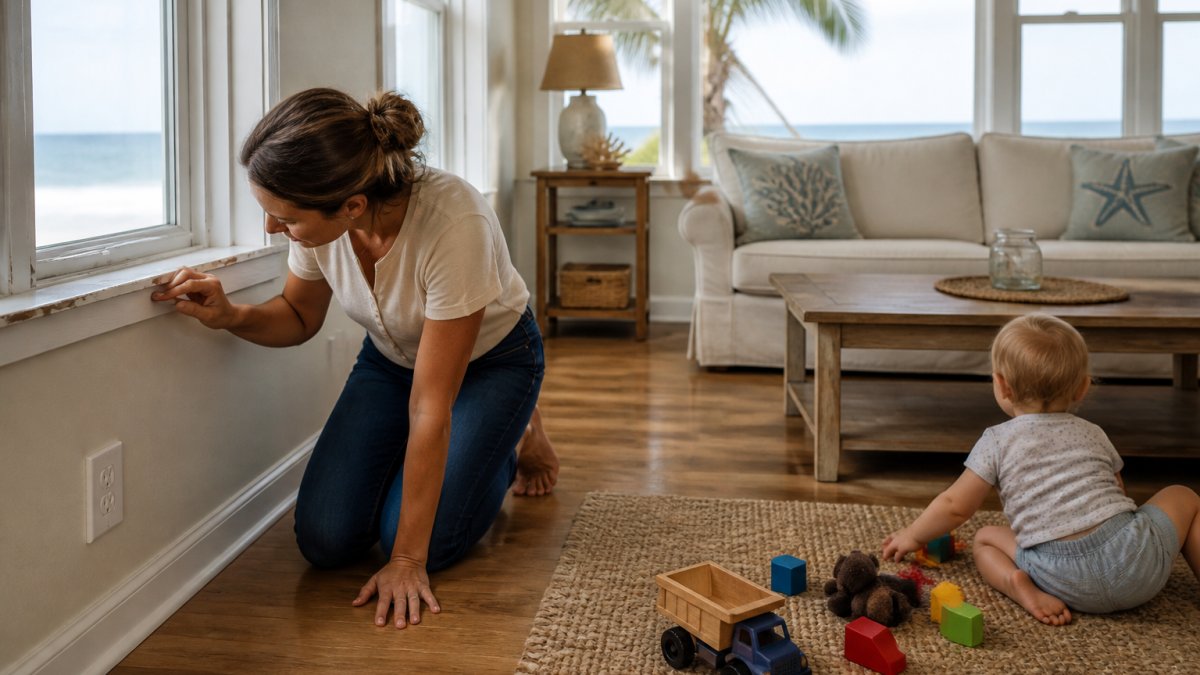
Parent inspecting a vintage windowsill and outlet in a restored 1950s vacation home living room with toddler toys nearby.
Lead Paint and Asbestos in Older Rentals
Homes built before 1978 may contain lead-based paint (the EPA). That is a federal cutoff date under the Residential Lead-Based Paint Hazard Reduction Act, not a guess.
Ask the host three specific questions:
Has the paint been tested with a lead test kit or by a certified inspector?
If lead was found, was it encapsulated, removed, or simply painted over?
Has any renovation happened in the last two years, and was the work area contained?
A simple DIY lead swab kit is widely available at hardware stores for under $20 and can confirm suspicious surfaces in minutes. It is not a substitute for a certified inspection, but it tells you whether to ask harder questions.
Asbestos turns up in old floor tile, pipe wrap, ceiling texture, and some window glazing.
Watch Out Do not sand, scrape, or aggressively clean painted surfaces in an older rental. Wet-wipe windowsills and floors instead of dry-sweeping, and keep toddlers from mouthing window hardware.
Electrical Grounding and Outlet Safety
Original 1950s wiring often lacks the third prong today's appliances expect, and many homes still have two-prong outlets in bedrooms and living areas. The practical risks are shock from ungrounded appliances and, in wet areas, the absence of ground-fault circuit interrupter (GFCI) protection.
Ask whether the home has been rewired or upgraded with grounded outlets and GFCI protection in kitchens, baths, laundry areas, and any outdoor outlet. Then do a two-minute check on arrival:
Look for the test/reset buttons on outlets near sinks and outdoors. No buttons means no GFCI.
Plug a small outlet tester (about $10 at any hardware store) into each outlet you plan to use. It confirms grounding and polarity in seconds.
Pack outlet covers anyway. It takes thirty seconds and removes the question entirely for lower outlets.
A common pattern in restored vintage rentals is a partial upgrade: the kitchen and baths were brought up to code, but bedroom outlets were left original. Ask specifically which rooms were upgraded.
Staircases, Railings, and Windows
Stair and window falls are the most common home injuries for young children, and 1950s homes frequently predate modern railing standards. The key measurement is the gap between balusters: if a child's head can pass through, the railing is a hazard. A common rule of thumb is that a 4-inch sphere should not pass through any gap, carry a tape measure or use a tennis ball as a quick proxy.
Check these specific points:
Baluster spacing: measure the widest gap on every railing, including the landing.
Handrail height and security: grab and pull the handrail; it should not move.
Stair gates: confirm whether the host provides one, and whether the banister shape allows a pressure-mounted gate (round or oversized banisters often require a hardware-mounted gate).
Windows: original windows may lack stops or guards, and upper-floor screens are not fall protection. Ask whether the host has installed window stops or guards on any window a child can reach.
Balcony railings: the same 4-inch rule applies, and climbable furniture near railings should be moved on day one.
A host who has thought about families will know the answers without checking. A host who has to go measure is still a better bet than one who has never considered it, but ask for the measurement, not the reassurance.
Key Takeaway You do not need to be an inspector to vet a 1950s rental. A $20 lead swab kit, a $10 outlet tester, and a tape measure cover the three highest-risk categories in about fifteen minutes.
Childproofing a Vacation Rental Before You Arrive
You cannot bolt furniture to the wall on a weekend trip, but you can do a lot with a small bag and a few questions. Childproofing a vacation rental starts before you pack.
Dramatic 1950s video demonstrates dangers to children around the home | RetroFocus
ABC News In-depth
Ask the host for a written safety summary of the property.
Request a crib or bed rail in advance if you need one.
Pack outlet covers, cabinet latches, and corner guards.
Bring a small first-aid kit and any medications in original packaging.
Photograph the pool area and any balcony on arrival.
Move cleaning products and cords out of reach on day one.
Confirm the nearest hospital and urgent care before bedtime.
A common mistake is assuming a listing marked "family-friendly" means childproofed. It usually means "kids are welcome." Those are different promises.
Your Child-Safe Vacation Rental Checklist
Use this child-safe vacation rental checklist as a walk-through on arrival. It takes about fifteen minutes and catches most problems.
Pool and deck: What to Check: Gate latch, self-closing door, no climbable furniture; Why It Matters: Drowning is the top rental risk for young children.
Stairs: What to Check: Baluster spacing, secure handrail, gate at top; Why It Matters: Falls are the most common home injury.
Outlets: What to Check: Covers on, GFCI in wet areas; Why It Matters: Shock risk in older wiring.
Windows: What to Check: Stops, guards, no loose screens; Why It Matters: Screens do not stop a fall.
Furniture: What to Check: Anchored bookcases, stable TVs; Why It Matters: Tip-over risk.
Cabinets: What to Check: Latches on cleaners and chemicals; Why It Matters: Poisoning risk.
Crib: What to Check: Firm mattress, tight sheet, no gaps; Why It Matters: Safe sleep for infants.
Research on approaches parents use to keep children safe at home shows that most injury prevention happens through simple environmental changes, not constant vigilance. The checklist above is that idea applied to a rental.
Questions to Ask a Vacation Rental Host About Child Safety
The right questions to ask a vacation rental host about child safety are specific ones. Vague questions get vague answers.
**1.
**2.
3. Are the outlets grounded, and are there GFCIs in the bathrooms? You want a yes with a room list.
**4.
5. Are cribs and high chairs available, and are they current models? You want a model name or a photo.
6. What is the closest hospital, and how far is it? You want a name and a drive time, not just a town.
7. Are there any steep stairs or open balconies? You want a yes/no plus a description of any railing gaps.
**8.
Pro Tip Ask these questions in writing through the booking platform so the answers are documented. A host who answers quickly and specifically is a host who has thought about families. A host who dodges them is telling you something too.
Beach House Safety Tips for Families
Water and sun cause more vacation injuries than architecture does. Balance the building checks with basic beach discipline.
Assign one adult as water watcher at all times. Rotate every 30 minutes.
Swim near a lifeguard when possible, and check rip current flags daily.
Apply sunscreen every two hours, and reapply after swimming.
Keep toddlers out of the sun during peak midday hours.
Hydrate constantly, and watch for heat exhaustion signs.
Rinse and dry ears after swimming to reduce infection risk.
Families planning a beach stay should also understand what direct, private, and public beach access really mean before booking. Access type changes how closely you can supervise kids near the water.
Supervision, Not Nostalgia: Setting Modern Standards
Nostalgia is a lovely reason to rent a 1950s home. It is a terrible safety plan. The charm of vintage architecture and the standards we expect today can coexist, but only when a host has done the work.
A home's age alone does not tell you whether it is safe for children. That is the CPSC's position too: unfamiliar rental homes carry hazards, and extra care is warranted around pools and elevators. So judge the property on maintenance, not on decade.
Watch out: the biggest mistake parents make is treating a rental like their own home, where they already know every hazard by memory. Walk the house like a stranger, because you are one.
Book a Restored 1950s Beachfront Villa With Confidence
Safety checks are not a reason to avoid historic homes. They are a reason to choose the right one. Our restored 1950s homes sit on a private stretch of beachfront, with direct beach access and rocket launch views from the deck. Families get space to gather, and parents get a property that has been cared for, not just decorated.
Frequently Asked Questions
What are the most common safety issues in 1950s houses?
The big ones are lead paint on old trim and windows, ungrounded two-prong outlets, loose stair railings, and single-pane windows that open wide. Asbestos can also turn up in old floor tile and pipe wrap. None of these make a house unusable, but each needs checking before kids run loose. Ask the host what has been updated and what has not, then walk the rooms yourself on arrival.
How can I tell if a vacation rental is safe for a toddler?
Start with the property listing and photos, then ask direct questions about outlet covers, stair gates, crib safety, and pool barriers. On arrival, do a five-minute walk-through: test every railing, check window stops, look for peeling paint at child height, and confirm smoke and carbon monoxide alarms work. The CPSC reported at least 64 fatal and non-fatal pool drownings in vacation rental homes involving children under 15 since 2021, so pool and water access deserves its own check.
Does a restored historic home meet modern safety expectations?
Only if the restoration was done with current building codes in mind. A 1950s vacation home can be perfectly safe for kids when wiring, railings, and windows have been brought up to modern standards and old paint has been addressed. The age of the house alone does not tell you either way. Ask the host for specifics on recent updates, and treat a clear, detailed answer as a better sign than a vague promise.
What should I pack to make a vacation rental safer for children?
Pack a small safety kit: outlet covers, cabinet latches, a foldable stair gate, corner guards, and a nightlight. Add a printed emergency contact list with local emergency services, the nearest hospital, and the host's number. For beach house safety tips for families, include life jackets sized to each child, swim diapers, and high-SPF sunscreen. These items cost little, fit in a suitcase, and cover the gaps a rental may not.
The challenge is simple: most vintage rentals were never set up with children in mind. We built ours differently, with restored 1950s homes, direct beach access, and room for the whole crew to stay together. Get started with Canaveral Beachfront Villas Llc and book a beachfront stay your family can relax into.