
Is a Beachfront Rental More Private Than a Hotel?
Last Updated: October 25, 2026
Quick Summary
A beachfront rental is generally more private than a hotel because you control a whole building and lot instead of a room off a shared corridor, elevator, and pool deck. For real beachfront privacy, confirm the property has its own direct path to the sand rather than a public access point. Detached beach houses and whole-property buyouts remove shared walls entirely.
Beachfront privacy has three layers: space you control, access you do not share, and sound at 7 a.m. and 11 p.m.
In Florida, the beach below the mean high water line is public, so private beach usually means private access.
Direct beach access means walking from the property to the sand without crossing a public road or municipal walkway.
Ask the host to describe the exact route from the door to the sand before comparing rates.
Request the full quote in writing and compare total cost, not the nightly rate.
Table of Contents
What Beachfront Privacy Actually Means in Cocoa Beach
The Three Layers of Privacy: Space, Access, and Sound
Cocoa Beach Vacation Rentals vs Hotels: Where Privacy Diverges
Shared Amenities vs Exclusive Use
Cocoa Beach Vacation Rentals with Direct Beach Access
Family-Friendly Cocoa Beach Beachfront Rentals: Space That Works
Privacy Trade-Offs by Accommodation Type
What Each Trade-Off Actually Costs You
What to Compare Before You Book a Private Beachfront Stay
The Total-Cost Worksheet
Verification Safeguards
Book Your Private Beachfront Stay in Cocoa Beach
Frequently Asked Questions
What Beachfront Privacy Actually Means in Cocoa Beach
Beachfront privacy is the degree to which a stay limits outside foot traffic, noise, and shared space, and it rarely comes down to the view alone.
The term gets used loosely. A condo tower can sit directly on the sand and still put hundreds of strangers in your elevator line. A beach house two blocks back can feel quieter than an oceanfront hotel.
The Three Layers of Privacy: Space, Access, and Sound
Here is the framework we use, and it is worth applying to any property you compare.
Space: How much of the property is exclusively yours. A whole home with its own deck and yard is a different category from a unit sharing a corridor.
Access: Whether the sand in front of you is open to the general public or limited to guests. In Florida, the beach below the mean high water line is public, so "private beach" almost always means private access, not a private shoreline. A property with its own walkway means you are not crossing a busy public boardwalk to reach the water.
Sound: What you hear at 7 a.m. and 11 p.m. Shared pools, elevators, and parking decks carry noise. A detached house on its own lot absorbs it.
That distinction matters because it changes what you are actually shopping for.
If you want the full definitions of direct, private, and public access before you book, our guide to vacation rentals with direct beach access breaks them down in depth.
Cocoa Beach Vacation Rentals vs Hotels: Where Privacy Diverges
The clearest difference between Cocoa Beach vacation rentals and hotels is control over shared space. A hotel gives you a room and a slice of a common pool.
Hotels win on service and predictability. Someone else handles linens, maintenance, and late check-in.
Rentals win on separation. You get walls that do not touch another guest's walls, a kitchen that is yours, and outdoor space that is not a communal deck.
Shared Amenities vs Exclusive Use
Think about what you actually use on vacation. If it is a pool, ask whether it is shared and how many units feed into it. If it is a balcony, ask whether it faces another building or open water.
For a direct comparison of alternatives, costs, and beach access, our breakdown of alternatives to Cocoa Beach oceanfront hotels covers the options side by side.
Cocoa Beach Vacation Rentals with Direct Beach Access
Direct beach access means you can walk from the property to the sand without crossing a public road or using a shared municipal walkway.
Here is why. Public beach access points concentrate people.
Data on guest satisfaction backs the general pattern that well-run rentals compete on experience rather than size. Happy Palm Stays' homes hold a median guest rating of 4.86 across 4,813 reviews, with 67% of rated listings scoring 4.8 or higher, according to AirROI's 2026 rental data.
What most guides miss is that access should be verified, not assumed. You can browse beachfront vacation homes in Cocoa Beach with direct access to compare options.
Family-Friendly Cocoa Beach Beachfront Rentals: Space That Works
The best family-friendly Cocoa Beach beachfront rentals solve one problem above all: keeping a group together without stacking them on top of each other.

Multi-generational family walking on a quiet beach for beachfront privacy near a restored 1950s house.
A common mistake is booking by headcount alone. Twelve people fit into a four-bedroom unit on paper.
Look for separate living areas, more than one bathroom, and outdoor space that is genuinely yours. Groups that want the whole property to themselves can explore whole property rentals and private events.
Privacy Trade-Offs by Accommodation Type
No accommodation type wins on every measure. The right choice depends on which layer of privacy you cannot compromise on, and the trade-offs are more concrete than most listings admit. Here is how the main types actually behave when you are standing on the property.
Oceanfront hotel: Space you control: Room only; Beach access: Shared, often public; Noise profile: Higher: hallways, elevators, pool deck, lobby; Best for: Short stays, full service.
Condo unit: Space you control: Unit plus shared amenities; Beach access: Shared walkway or public access point; Noise profile: Moderate: shared corridors, adjacent units, parking deck; Best for: Couples, small families.
Townhouse: Space you control: Multi-level, own entrance; Beach access: Usually direct or nearby; Noise profile: Lower: one shared wall at most; Best for: Groups of 6-8.
Detached beach house: Space you control: Whole building and lot; Beach access: Direct, exclusive path; Noise profile: Lowest: no shared walls, own outdoor space; Best for: Multi-generational groups.
Whole-property buyout: Space you control: Entire grounds; Beach access: Exclusive; Noise profile: Lowest: no other guests on site; Best for: Reunions, small events.
What Each Trade-Off Actually Costs You
The pattern is consistent: the more of the property you control, the more privacy you get. That control is also what you pay for, and it is the piece budget comparisons usually leave out.
Hotels trade privacy for service. You get linens, maintenance, and a front desk, but you share every circulation space with everyone else on the property. A room on a high floor away from the elevator is quieter than one beside the ice machine, but you are still inside a shared building.
Condos trade privacy for amenities. A shared pool and gym are real value, but they also mean shared hours, shared noise, and a parking deck that fills up. Ask how many units feed into the pool and whether the balcony faces open water or another building.
Townhouses trade privacy for density. You get your own entrance and usually a direct path to the sand, but you share at least one wall and often a driveway. Noise depends heavily on who is next door.
Industry expectations point the same way. Most property managers surveyed for the 2026 Vacation Rental Industry Outlook expect stability or only modest growth in average daily rate, occupancy, and revenue, which suggests operators are competing on quality and experience rather than steep discounting.
Key Takeaway Pick the type by the layer of privacy you cannot give up. If sound is the dealbreaker, a detached house or buyout is the only category that removes shared walls entirely. If access is the dealbreaker, confirm the route from door to sand before you compare rates.
For a direct comparison of alternatives, costs, and beach access, our breakdown of alternatives to Cocoa Beach oceanfront hotels covers the options side by side.
What to Compare Before You Book a Private Beachfront Stay
Compare total cost, verified access, and cancellation terms before you compare photos. Those three decide whether the stay matches the listing, and they are the three most listings are least transparent about.
The Total-Cost Worksheet
Nightly rate is the smallest part of the number you will actually pay. Build the full quote before you shortlist:
Nightly rate by season. Ask for the rate for your exact dates, not the lowest advertised rate. Seasonal variation in beach markets can be substantial.
Cleaning fee. Usually a flat charge per stay, so it hurts short trips more than long ones. Ask whether it changes with group size.
Taxes and local surcharges. These vary by jurisdiction and are often quoted separately from the rate.
Resort or amenity fees. Common at condos and hotel-like properties. Ask what the fee covers and whether it is mandatory.
Ask for the full quote in writing and compare the total, not the nightly rate. A property that looks $40 higher per night can be cheaper overall once fees and parking are included.
Verification Safeguards
Use this checklist on every property you shortlist:
Access route. Ask the host to describe the walk from the door to the sand, and whether it crosses public property or a shared municipal walkway.
Private vs shared amenities. Confirm whether the pool, deck, and beach path are exclusive to your group or shared with other units.
Recent photos and reviews. Request current photos of the specific unit, not a sister property. Read reviews from the last six months.
Group fit. Confirm bedroom count, bathroom count, and whether any sleeping space is a pull-out.
That last point deserves emphasis. Launch schedules shift for weather and range conditions, so treat a launch as a bonus rather than a guarantee.
Watch Out A "private beach" claim almost always means private access, not a private shoreline. In Florida, the beach below the mean high water line is public, so verify the access route rather than the wording of the listing.
On cost, we will not quote you a number here, because pricing depends on dates, group size, and season. Ask for a current quote directly.
Book Your Private Beachfront Stay in Cocoa Beach
The gap between a beachfront listing and a private beachfront stay comes down to three things: space you control, access you do not share, and a setting quiet enough to hear the surf. Most travelers compare nightly rates and stop there. The better question is what those rates actually buy you in separation.
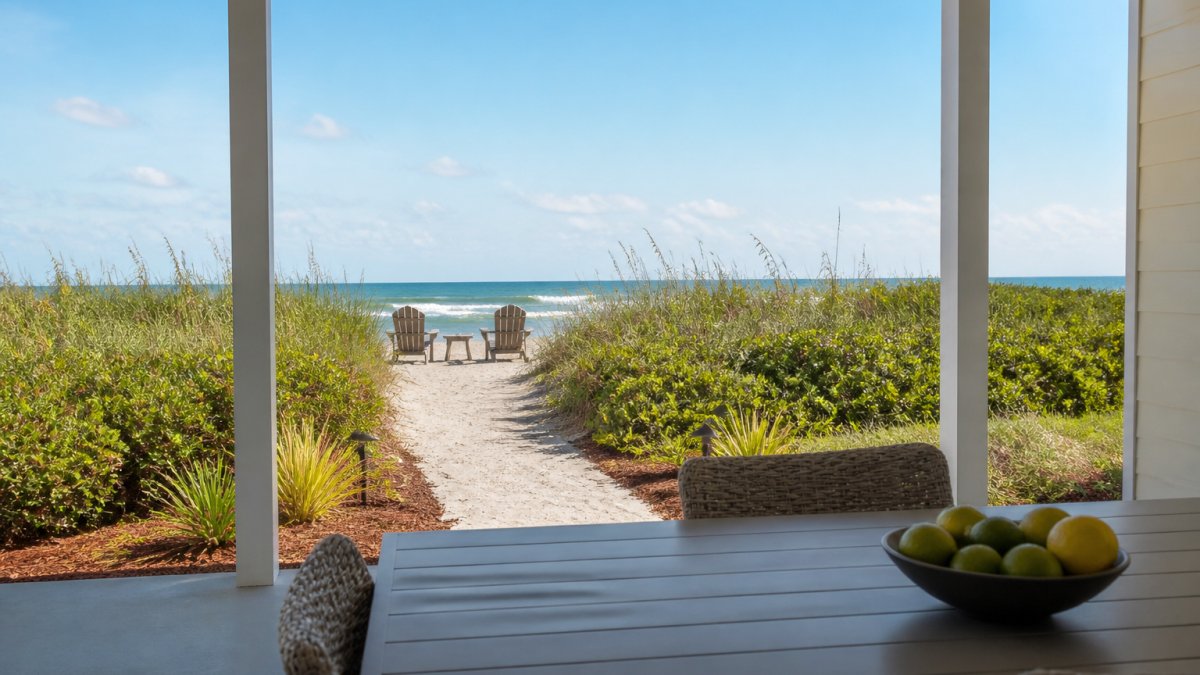
Our restored 1950s homes sit on 1.4 acres of private beachfront in Cocoa Beach, with direct beach access and a front-row view of rocket launches from your own deck. Families and groups get room to spread out, a historic setting that is genuinely original rather than staged, and a beach that feels like it belongs to the property. If you have questions about group stays, pets, or availability on short notice, contact our team and we will respond promptly.
Comparing beachfront options is easy. Finding one where your group has the sand, the deck, and the quiet to yourselves is the harder part, and it is the part worth getting right before you pay a deposit.
Frequently Asked Questions
Are beachfront villas more private than hotels?
Usually, yes, because a villa gives your group exclusive use of the building and its outdoor space. A hotel puts strangers on the same pool deck, the same elevator, and often the same stretch of sand. Beachfront privacy comes down to three things: whether the space is yours alone, how close the beach access is, and how much foot traffic passes your door. A private 1.4-acre property with direct beach access removes the shared-lobby and shared-pool problem entirely, which is the main reason groups switch from hotels to villas.
How can I check whether a vacation rental has direct beach access?
Ask the host to confirm the access type in writing: a private path, a shared boardwalk, or a public crossover a few blocks away. Then check the property on a map and look for roads, parking lots, or other buildings between the house and the sand. Reviews often mention the walk. For Cocoa Beach vacation rentals with direct beach access, the difference between a 30-second walk and a 10-minute drive changes how you use the beach all day, especially with kids or gear.
What should I compare when choosing a private beachfront rental in Cocoa Beach?
Compare total cost including cleaning and service fees, not just the nightly rate. Check whether the beach access is private or shared, how many bedrooms and bathrooms your group needs, and whether parking fits every car. Confirm the pet policy in writing if you are bringing dogs, and ask for recent photos of the actual unit. Pricing depends on dates and group size, so request a quote for your specific stay.
What amenities should families look for in a Cocoa Beach beachfront rental?
Families with kids usually need a full kitchen, laundry, enough bedrooms that everyone sleeps well, and outdoor space where children can be watched from the deck. A private pool or direct beach access cuts down on packing and driving. Ask about staircase safety for toddlers and whether the yard is fenced. For family-friendly Cocoa Beach beachfront rentals, the layout matters as much as the location: a house where grandparents and kids each have their own floor beats a hotel suite every time.