
Best Time to See Rocket Launches in 2026?
Last Updated: October 30, 2026
Quick Summary
There is no single best time to see rocket launches in 2026, because the right answer depends on the mission, the launch window, and where you plan to stand. Confirm the scheduled launch and its window first, then decide whether a daytime or evening liftoff suits your group, and build in flexibility because scrubs happen.
A firm launch time means arriving 60 to 90 minutes early, since the window will not wait.
A no-earlier-than listing can slip by hours, so block the whole afternoon or evening.
Check the schedule again 48 hours out, then again the morning of the launch.
Build in a two-day buffer on either side of a specific mission date.
Early morning and late evening launches often give the clearest, most photogenic light.
Table of Contents
Why the Best Time to See Rocket Launches in 2026 Depends on the Mission
The 2026 Rocket Launch Schedule: What's on the Calendar
What a 2026 calendar entry actually tells you
Missions and vehicles to watch in 2026
How to read a launch calendar and track updates
Daytime vs. evening launches: the two 2026 examples
Best Time of Day to See a Rocket Launch
Cocoa Beach Rocket Launch Viewing: What to Expect from the Sand
Viewing locations beyond Florida
Rocket Launch Weather Delays and Scrubs: How to Plan Around Them
The weather rules that actually scrub a launch
How to read conditions as a viewer
Plan for the scrub, not just the launch
How to Plan a Viewing Trip: Months, Seasons, and Booking Windows
Book a Deck with a Front-Row Seat for the 2026 Launches
Frequently Asked Questions
Why the Best Time to See Rocket Launches in 2026 Depends on the Mission
There is no single best time to see rocket launches in 2026. The right answer depends entirely on the mission, the launch window, and where you plan to stand.
Guests often ask whether their dates line up with a launch, and the honest answer is always the same: check the mission, not the month.
A simple framework helps. First, confirm the scheduled launch and its window. Second, decide whether a daytime or evening liftoff suits your group. Third, build flexibility into your plans, because scrubs happen. The Kennedy Space Center's launch viewing guidance makes the point plainly: every launch is different, and packages may cover liftoffs in the middle of the night.
That last detail matters more than most guides admit.
The 2026 Rocket Launch Schedule: What's on the Calendar
The 2026 rocket launch schedule is a moving target, updated as missions slip, stack, and re-manifest. The useful skill is reading those dates correctly. A calendar entry is a plan, not a promise, and the difference between a firm liftoff time and a "no earlier than" window changes how you should plan your day.
Two entries illustrate how wide the timing range runs. Visit Space Coast's launch schedule and countdown lists a Falcon 9 launch on October 1, 2026, at 11:10 a.m. and a Vulcan launch on November 12, 2026, at 7:00 p.m. Same coastline, same viewing areas, completely different experience.
What a 2026 calendar entry actually tells you
Most public schedules show four fields: the mission name, the launch vehicle, the launch site, and a time. The time field is where viewers get tripped up. A firm time ("11:10 a.m. EDT") means the window is narrow. A "no earlier than" time means the rocket can go later the same day, and a TBA means the operator has not committed to a date at all. Treat each differently:
Firm time: plan to arrive 60-90 minutes early; the window will not wait.
No earlier than: block the whole afternoon or evening; the launch can slip by hours.
TBA: do not book travel around it; watch for the date to firm up.
Missions and vehicles to watch in 2026
Competitors organize 2026 by quarter, and that structure helps viewers because launch cadence clusters. Rather than memorize every mission, track the vehicles you are most likely to see from the Space Coast:
Falcon 9: the most frequent flyer, with dozens of Starlink and commercial missions across the year; daytime and nighttime launches are both common.
Falcon Heavy: fewer flights, but a heavier, brighter ascent that is visible farther inland.
Vulcan Centaur: a newer vehicle with a growing manifest; its 2026 flights include the November 12 evening launch noted above.
Space Launch System (SLS): tied to the Artemis program; when it flies, it is the largest and most visible vehicle on the pad.
Mission names matter too. A crewed mission or a high-profile science payload often draws crowds and media, while a routine Starlink batch may launch with little fanfare but is just as visible from the beach. If your trip is flexible, aim for a week with multiple scheduled launches rather than a single date.
How to read a launch calendar and track updates
Launch calendars are living documents, not tickets. A listing marked "no earlier than" can move by hours or weeks.
Check the schedule again 48 hours out, then again the morning of
Follow the spaceport's own updates rather than a screenshot you saved last month
Note whether the listing shows a firm time or a window
Cross-check two sources; a single calendar can lag behind a scrub
Pro Tip If you are planning a trip around a specific mission, build in a two-day buffer on either side. A single launch date has a real chance of moving, and a backup attempt is often the one you actually see.
Daytime vs. evening launches: the two 2026 examples
A daytime launch gives you a clean contrail against blue sky, easy photography, and no need to rearrange dinner. An evening launch gives you the flame plume lighting up the dark, a far more dramatic sight, but it also means late bedtimes for kids and a longer wait on the sand.
Best Time of Day to See a Rocket Launch
The best time of day to see a rocket launch is whichever window the mission actually flies in, but viewing conditions do favor certain hours. Early morning and late evening launches often give the clearest, most photogenic light, while midday launches are easiest to plan around with children.
Here is how the trade-offs break down:
Early morning: What You See: Crisp contrail, soft light; Best For: Photographers, early risers; Watch Out For: Pre-dawn wake-ups with kids.
Midday: What You See: Clean blue-sky plume; Best For: Families, first-timers; Watch Out For: Harsh glare on the water.
Late afternoon: What You See: Warm light, long shadows; Best For: Casual viewers; Watch Out For: Heat and sun exposure.
Evening and night: What You See: Bright flame against dark sky; Best For: Drama, group outings; Watch Out For: Late hours, longer waits.
For a family with young children, a daytime launch may be easier to manage than a night launch.
Cocoa Beach Rocket Launch Viewing: What to Expect from the Sand
Cocoa Beach rocket launch viewing offers space to spread out, sand under your feet, and an open line of sight to the pad. For the full step-by-step plan, see our guide to viewing rocket launches in Cocoa Beach.
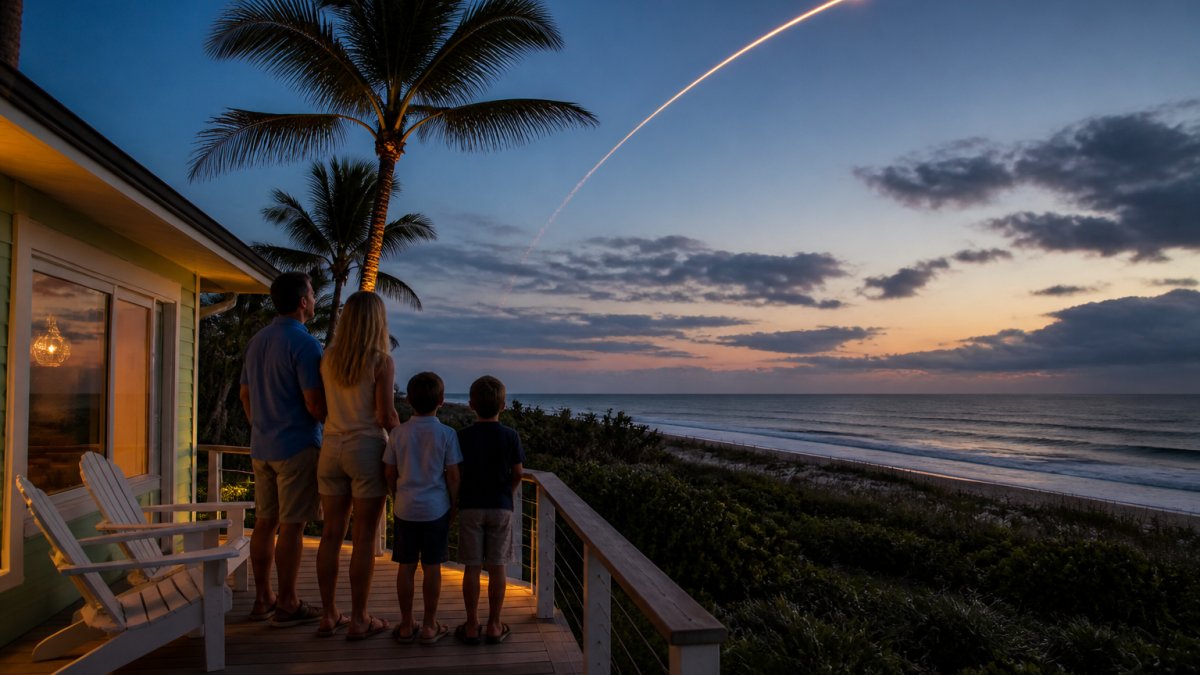
Family watching rocket launches from a vintage beach house deck at dusk
The delay between sight and sound surprises first-timers. You watch the rocket climb in near silence, then the rumble arrives. That gap is normal, and it is part of the experience.
Viewing locations beyond Florida
Not every launch is visible from the beach, and not every trip lines up with one. Plenty of visitors pair a launch-watching stay with the rest of what the area offers, from surfing to wildlife to dining. See our things to do in Cocoa Beach for nearby attractions and launch-viewing options.
Rocket Launch Weather Delays and Scrubs: How to Plan Around Them
Rocket launch weather delays are a common reason a viewing trip ends without a liftoff. Upper-level winds, lightning within range, and thick cloud cover can all push a launch to a backup window, sometimes with only minutes of notice. Most guides stop at "check the forecast." The useful angle is understanding why scrubs happen and how to read the conditions yourself.
The weather rules that actually scrub a launch
Launch operators follow strict weather criteria, and a violation of any one can scrub a launch even if the sky above your beach chair looks fine:
Lightning within range: a strike within a defined radius of the pad or flight path triggers a hold; Florida's afternoon storms make this the most common summer scrub.
Upper-level winds: winds aloft can shear a vehicle during ascent; these are invisible from the ground and often the reason a clear-day launch is delayed.
Cloud cover and ceiling: thick clouds can obscure tracking and violate visibility rules, and a low ceiling can ground a launch even in calm air.
Downrange conditions: weather along the flight path and at the landing zone matters, not just at the pad.
A common pattern is a launch that holds at T-10 minutes while the range waits on a single weather rule, then goes or scrubs within the window. That is normal, not a sign something is wrong.
How to read conditions as a viewer
You do not need a meteorologist to make a reasonable call. Before you head to the beach:
Check the official launch weather forecast, which most operators publish the day before and update on launch day.
Watch the local radar for storm cells moving toward the coast; an afternoon thunderstorm can scrub a launch hours before it arrives.
Note the wind direction; onshore winds can push clouds and storms over the pad.
Follow the launch broadcast for hold and scrub calls, which usually come with a reason.
Watch Out A scrub is not a cancellation. Backup windows are often announced within a short period, which is why a buffer day is a sensible addition to a viewing trip.
Plan for the scrub, not just the launch
Book at least one buffer day on either side of the scheduled date
Have a backup plan for the same evening, such as a beach walk or a restaurant reservation
Check the forecast the morning of, and again two hours before the window
Treat a postponement as normal, not as bad luck
Watch out: booking a single-night stay around a launch leaves you no room to catch a backup attempt.
How to Plan a Viewing Trip: Months, Seasons, and Booking Windows
Planning a viewing trip comes down to three variables: when launches cluster, what the weather does, and how far ahead you book. Launch cadence varies month to month, so a flexible calendar beats a fixed one.
Launch schedules shift regardless of season, so flexible dates are useful.
On booking: launch dates can drive demand, so checking availability early is sensible. If your plans firm up late, our guide to booking Cocoa Beach villas last minute explains how to check availability and compare rates before you reserve.
Book a Deck with a Front-Row Seat for the 2026 Launches
Our restored 1950s homes sit on a private 1.4-acre beachfront property, with direct beach access and views of rocket launches from your own deck. Families and groups get the space to gather.
Questions about dates or group bookings? Reach out to our team.
Frequently Asked Questions
What is the best time of year to see a rocket launch in 2026?
There is no single best month. The 2026 schedule spreads missions across the calendar, and Pick months when you can travel flexibly, then match your dates to the published 2026 rocket launch schedule rather than the season. Launch cadence, not weather, decides what you can see.
What time of day are rocket launches usually scheduled?
Launch times vary by mission and orbital requirements. Launch times vary, so both daytime and evening slots are possible. Check the best time of day to see a rocket launch against your own schedule, and keep the whole evening or morning free in case the window shifts.
Can I see a rocket launch from Cocoa Beach?
Yes. Cocoa Beach sits on the Atlantic coast, and a beachfront property with a private deck can offer a view of launches. Confirm the mission status before you settle in.
How do rocket launch weather delays affect my viewing plans?
Rocket launch weather delays are common and can push a launch by minutes, hours, or days. Upper-level winds, lightning, cloud cover, and range conditions all factor into the decision. Build a buffer day into any trip planned around a single launch, and check the mission status the morning of the attempt. If a scrub happens, stay flexible and check the mission status for the next window.
How far in advance are rocket launch dates confirmed?
Dates often appear weeks or months ahead on a 2026 rocket launch schedule, but they are not guaranteed. Treat any listed time as a target, not a promise. Book refundable or flexible lodging, and recheck the schedule in the days before you travel.
Where can I check whether a launch is still on schedule?
Use a live launch tracker or schedule site that shows mission status, countdown timers, and launch windows. Cross-check two sources on launch day.
The 2026 launch calendar rewards planning and punishes rigidity. Build in a buffer day, watch the schedule closely, and give your group a comfortable place to wait out a scrub. Get started with Canaveral Beachfront Villas Llc and watch the next launch from a deck on the sand.