
7 Beachfront Properties With Private Access for Families
Last Updated: November 5, 2026
Quick Summary
A beachfront property with private access is a home or rental where guests reach the sand through a controlled entry the public does not share, either through owned shoreline or a deeded path, boardwalk, or gate. Because private beach access is a marketing phrase rather than a legal term, ask the host in writing whether the beach itself is privately owned or only the access is private.
Owned shoreline lets you restrict who walks the sand; controlled access may lead to a public beach.
Ask the host in writing whether the beach is privately owned or just the access.
County property appraiser records show who owns the parcel and where the boundary sits.
Canaveral Beachfront Villas sits on 1.4 acres of beachfront in Cocoa Beach with restored 1950s homes.
A listing that says steps to the beach tells you nothing about access.
Table of Contents
What Private Beach Access Really Means on a Beachfront Property
Owned Shoreline vs. Controlled Access: The Distinction That Changes Your Stay
How to Verify Access Rights Before You Book
1. Canaveral Beachfront Villas: Restored 1950s Homes on 1.4 Private Acres
2. Exclusive 30A: A Dedicated Private-Beach-Access Collection
3. Vacasa: Beach-Access Rentals With Heated Saltwater Pools
4. AvantStay: A 10-Bedroom Estate With a Private Boardwalk
5. Insider Villas: Staffed Estates and Island Retreats
What Families Should Check in Beachfront Vacation Rentals for Families
Comparing Private Beach House Rentals Oceanfront Across Regions
Frequently Asked Questions
What Private Beach Access Really Means on a Beachfront Property
A beachfront property with private access is a home or rental where guests reach the sand through a controlled entry that the public does not share. That access can come from ownership of the shoreline itself or from a deeded path, boardwalk, or gate the property controls. The distinction matters more than any listing photo suggests.
Here is the short version: "private beach access" is a marketing phrase, not a legal term. It can mean a stretch of shore the owner actually holds title to, or it can mean a shared path with a keypad at the entrance. Both get called private. Only one gives you the empty morning shoreline most travelers picture.
Below, we break down seven properties and platforms that advertise private access, what each one actually delivers, and how to check the claim before you pay a deposit.
Owned Shoreline vs. Controlled Access: The Distinction That Changes Your Stay
Owned shoreline means the property's boundary runs to the water and the owner can restrict who walks on it. Controlled access means the property has a legal right of way to the sand, often through a gate or along a private path, but the beach itself may be public.
The practical difference shows up on a Saturday in July. With owned shoreline, you spread out and stay put. With controlled access, you get a shorter walk to a beach that fills up like any other. Neither is a scam. They are just different products wearing the same label.
If privacy is the reason you are booking, ask which one you are getting before you compare nightly rates.
How to Verify Access Rights Before You Book
The fastest check is a direct question to the host, phrased so it cannot be dodged: "Is the beach in front of the property privately owned by the property, or is access private while the beach is public?" Ask it in writing and keep the reply.
Then confirm it yourself. County property appraiser records show who owns the parcel and where the boundary sits. Many coastal counties publish parcel maps online, and the local planning or code office can tell you whether a path is deeded or a shared easement. For rentals, a host who has done this homework answers without hesitation.
Watch out: a listing that says "steps to the beach" has told you nothing about access. Steps can lead to a public crossover shared with the whole street.
1. Canaveral Beachfront Villas: Restored 1950s Homes on 1.4 Private Acres
Our own property sits on 1.4 acres of beachfront in Cocoa Beach. The homes are restored 1950s villas and townhouses, and guests reach the beach directly from the property.
The setting suits groups. Multi-generational families, reunion crews, and friends traveling together can gather on one piece of shore, with a shared deck to gather on.
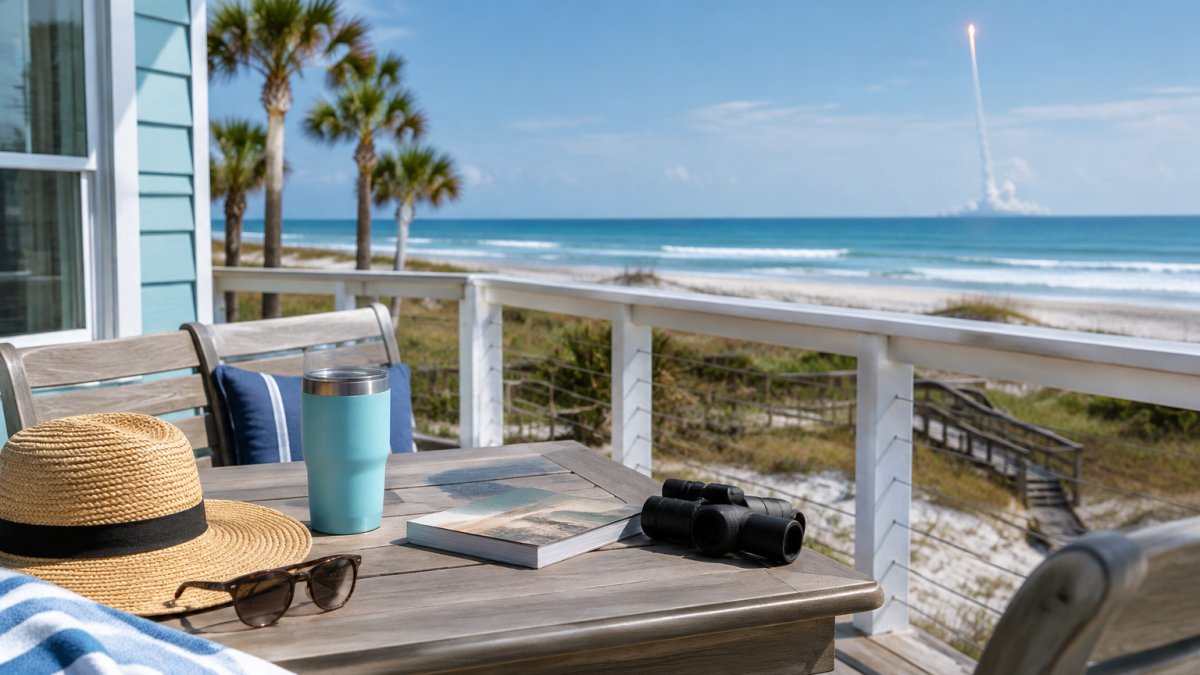
Then there is the view. Guests can enjoy a front-row view of rocket launches from their own deck. Launches depend on weather and mission timelines, so treat one as a bonus, not the reason for the trip.
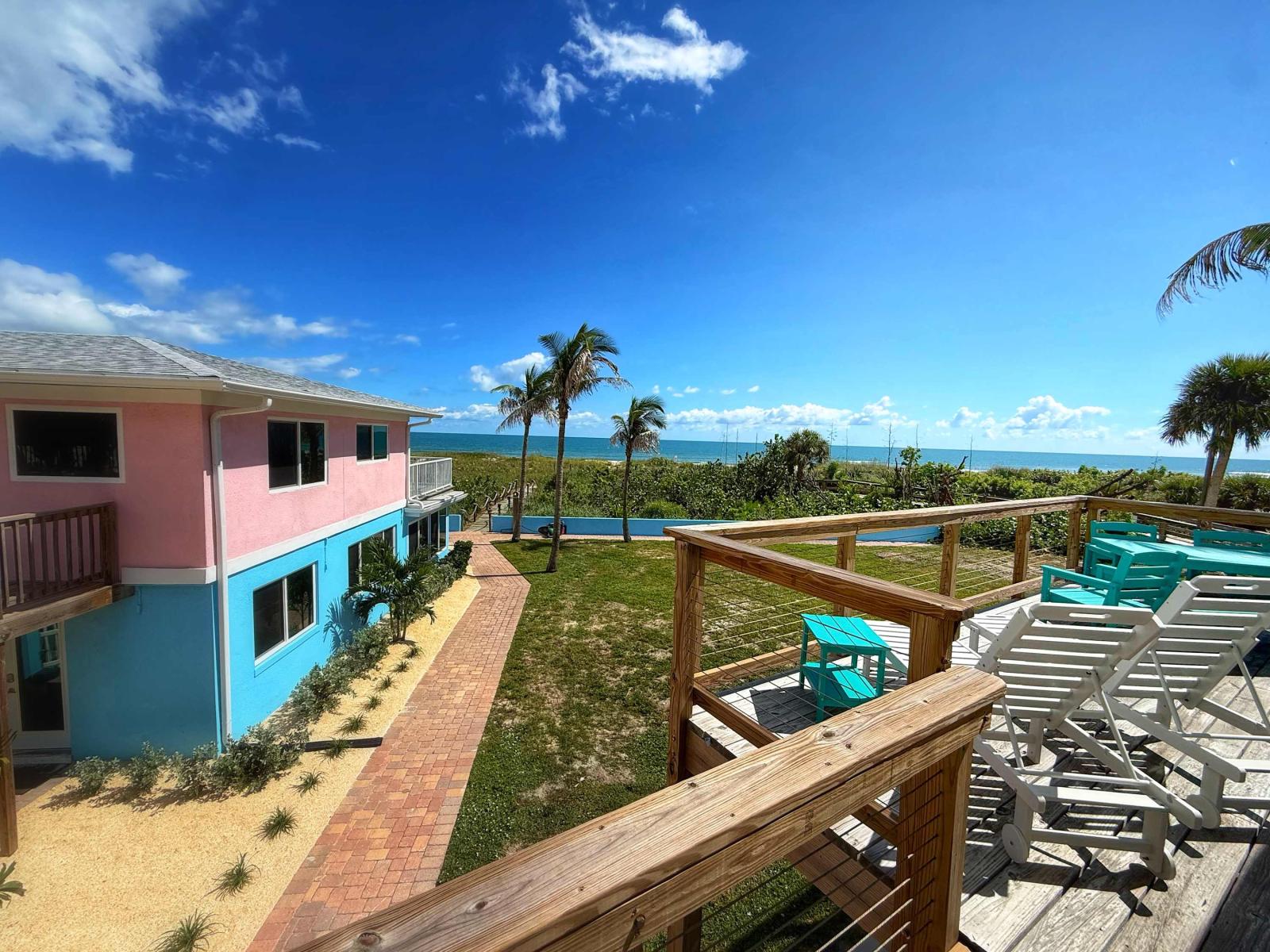
Pink and turquoise beachfront house with wooden deck, white lounge chairs, palm trees, and ocean view under blue sky.
For families weighing an older home, these are restored 1950s buildings. Learn more about the property and its 1.4-acre beachfront setting.
2. Exclusive 30A: A Dedicated Private-Beach-Access Collection
Best for: travelers set on the 30A corridor who want a curated list rather than a general search. Skip if: you need confirmed ownership of the shoreline, which requires asking each host directly.
3. Vacasa: Beach-Access Rentals With Heated Saltwater Pools
Scale cuts both ways here. A large platform means plenty of inventory and reliable booking systems, but the phrase "beach access" gets applied broadly across thousands of properties. The pool and the access claim are not guaranteed to appear together on every listing you click.
Best for: travelers who want a pool as part of the package and are willing to filter carefully. Skip if: you want a single owner accountable for the access claim. On a platform this size, you are dealing with many hosts.
4. AvantStay: A 10-Bedroom Estate With a Private Boardwalk
A private boardwalk is controlled access in its clearest form. It is genuinely private in the sense that matters on vacation, meaning you are not sharing the route with the public, even where the beach itself is not owned by the property. The guide format also means the featured homes are a selection, not the full inventory.
Best for: big groups that need ten bedrooms and a straightforward walk to the water. Skip if: you want to compare many properties side by side. A guide shows highlights, not the whole market.
5. Insider Villas: Staffed Estates and Island Retreats
This is the top of the market, and it is a different product from a family beach rental. A staffed estate on its own beach is about as private as access gets, because the property controls the shoreline and the staff. The trade-off is distance and price transparency: the supplied listings do not show rates, and most of these properties require a flight rather than a drive.
Best for: travelers planning a milestone trip who want staff, seclusion, and an international setting. Skip if: you are booking a long weekend within driving distance. This collection is built for longer, farther trips.
What Families Should Check in Beachfront Vacation Rentals for Families
Start with the access question, then move to the house itself. Families with young children need to know how far the sand is, whether the path is stroller-friendly, and whether the shoreline drops off steeply. A direct path across flat sand is a different experience from a staircase down a dune.
Inside the home, the checks that matter most are the unglamorous ones:
Bedroom count and bed sizes match your group, not just the headline capacity
Stair rails and gates are secure if toddlers are coming
Pool or hot tub areas can be closed off from small children
The host confirms pet policy, fees, and size limits in writing
Recent photos show the actual unit, not a sister property
The access route is described specifically, not as "near the beach"
Older homes deserve a closer look. If the property dates to the mid-20th century, ask what has been updated and request current photos of the rooms you will sleep in. Our guide to the seven safety checks for 1950s vacation homes walks through lead paint, stair rails, and the rest of the list.
Comparing Private Beach House Rentals Oceanfront Across Regions
The same "private access" label buys very different things depending on where you book. The table below is a starting map, not a substitute for the verification steps above. Use it to narrow regions, then confirm the access type property by property.
Space Coast, Florida: Typical Access Type: Direct property access to sand; What Private Usually Means: Controlled entry from the property; shoreline rules vary by parcel; Best For: Families, launch viewing, cruise departures.
30A corridor, Florida: Typical Access Type: Mixed: private walkovers and community paths; What Private Usually Means: Varies by home; confirm per listing; Best For: Curated browsing, walkable beach towns.
Hilton Head, South Carolina: Typical Access Type: Private boardwalks from large estates; What Private Usually Means: Controlled path to a public beach; Best For: Big groups needing ten or more bedrooms.
Gulf Coast and Keys: Typical Access Type: Private access plus resort-style amenities; What Private Usually Means: Often paired with heated pools; Best For: Families wanting pool and sand.
Caribbean and international: Typical Access Type: Owned shoreline on staffed estates; What Private Usually Means: Property controls the beach itself; Best For: Milestone trips, longer stays.
Two costs hide in that table, and both are where listings go quiet.
Total cost of the stay. A lower nightly rate on a controlled-access property can be erased by parking fees, beach chair and umbrella rentals, gate or community fees, cleaning charges, and the drive to a public access point. Build a full-trip number before you compare: nightly rate times nights, plus taxes and destination fees, plus cleaning, plus parking, plus any access or amenity fee, plus a realistic estimate for chairs and umbrellas if the property does not supply them. For buyers, the total cost of ownership is a different calculation: property taxes, flood insurance, wind and storm coverage, maintenance on a coastal structure, HOA dues, and any access-related assessments. A headline sale price tells you almost nothing about the annual carrying cost of a beachfront parcel.
Coastal risk and due diligence. Storm season, erosion, and local rules about shoreline structures can change what access looks like from one year to the next. Ask the host or seller what the path has looked like after the most recent storm season, whether any dune or shoreline regulation limits rebuilding or maintaining a walkover, and whether flood insurance is required and available for the property. For buyers, pull the flood zone designation and check whether the property has a history of erosion or shoreline armoring permits. These are the questions that separate a decision-ready comparison from a listing snippet.
A consistent comparison also needs the same fields for every property: location, access type (owned shoreline, deeded easement, community walkover, or public crossover), price and full fee schedule, guest capacity and bedroom count, amenities, and a verification note recording what the host confirmed in writing. Standardizing those fields is what makes a shortlist useful across regions rather than a pile of unstandardized listings.
For a closer look at bookable homes with direct access across regions, browse the beachfront vacation homes collection and compare space, access type, and total cost before you commit. If privacy versus a hotel is the real question, this comparison of rental privacy and hotel stays covers it in more depth, and our guide to direct beach access nationwide explains what direct, private, and public access mean before you book.
Frequently Asked Questions
What does private beach access mean at a vacation rental?
It usually means one of two things: the property owns the shoreline in front of it, or the owner controls a dedicated path or gate to a public beach. Ask the host which one applies before you book, and request the access agreement or deed language in writing so you know exactly what you are paying for.
Is direct beach access the same as private beach access?
No. Direct beach access means you can walk to the sand without crossing a road or driving, but the beach itself may be public and open to anyone. Private beach access means entry is limited to guests or owners. A beachfront property with private access combines both: a short walk and a controlled entry. Confirm which term a listing actually uses, because marketers often swap them.
What should families look for in beachfront vacation rentals for families?
Check bedroom count against your group size, bathroom ratio, and whether the sleeping arrangements work for kids and grandparents. Ask about water conditions at the access point, lifeguard coverage, and whether the path is stroller-friendly.
Are beachfront rentals with private access worth the cost?
Compare the total cost of stay, including cleaning and service fees, rather than the nightly rate alone.
How do I verify access rights before booking a beachfront property?
Ask the host for the specific access type in writing: deeded shoreline, an easement, or a controlled gate. Request photos of the path and entry point, and confirm whether the beach beyond it is public. Read recent guest reviews for mentions of the walk, and get cancellation terms in writing before you pay.